Waqar Younis Biography
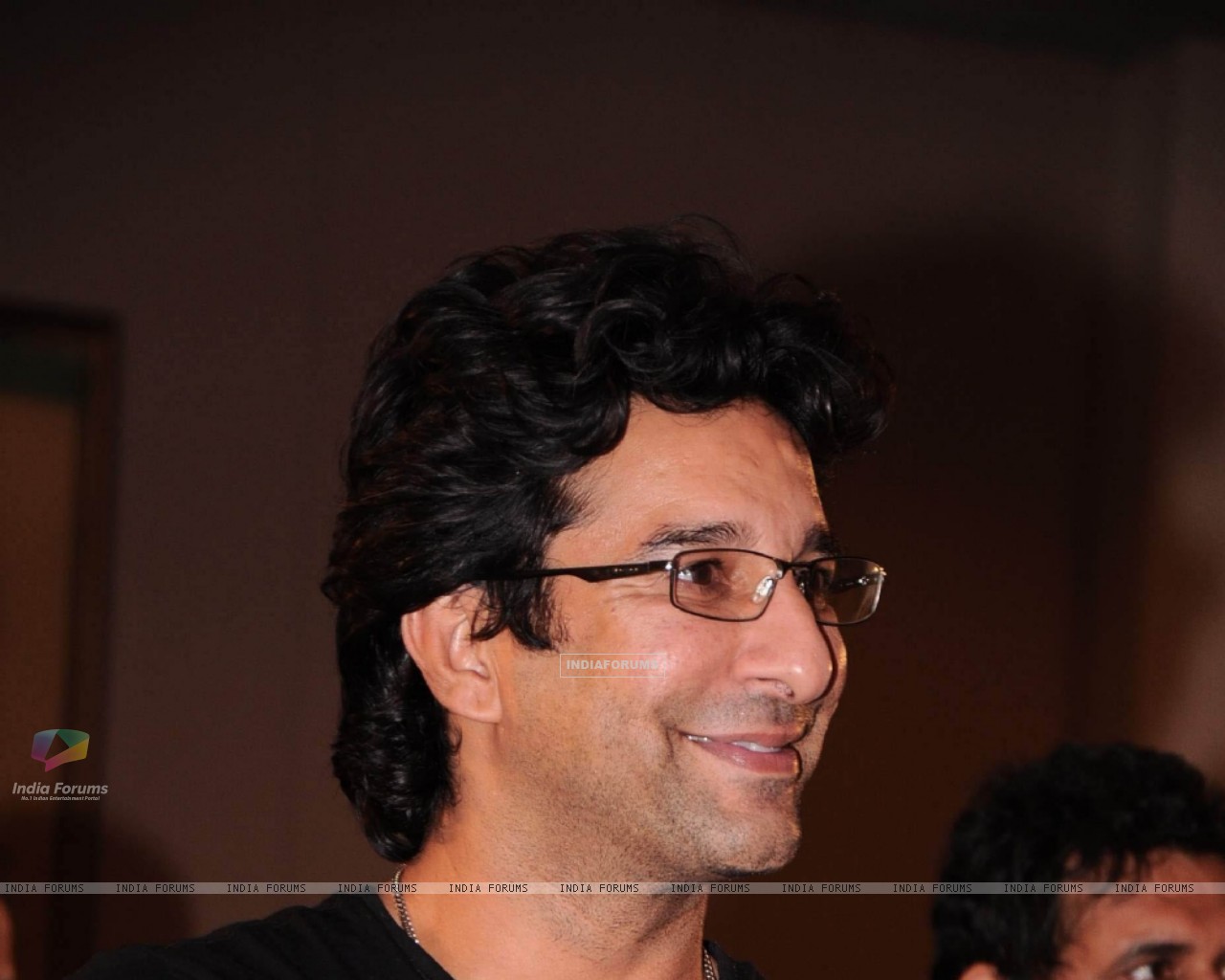
Waqar Younis Maitla is a former Pakistani right arm fast bowler born in Vehari Punjab. He is one of the top ten cricketers of all time and got worldwide fame. He is well known in cricket for his ability to “reverse swing a cricket ball” at high speed while bowling at cricket pitch. During his career he took “373 Test Wickets” and “416 One Day International Wickets”. Waqar Younis is considered as one of the best exponents of swing bowling delivery. He has a best strike rate for any bowler with more than “200 Test Wickets”.
Personal Information of Waqar Younis
Personal information
Full name Waqar Younis Maitla
Born 16 November 1971 (age 39)
Vehari, Punjab, Pakistan
Height 1.80 m (5 ft 11 in)
Batting style Right hand bat
Bowling style Right arm fast
Role Bowler
Domestic Team InformationDomestic team information
Years Team
2003-2004 Allied Bank Limited
2003 Warwickshire
2001-2003 National Bank of Pakistan
2000-2001 Lahore Blues
1999-2000 REDCO Pakistan Limited
1998-1999 Rawalpindi
1998-1999 Karachi
1997-1998 Glamorgan
1990-1993 Surrey
1988-1989, 1996-1997 United Bank Limited
1987-1988, 1997-1998 Multan
International InformationInternational information
National side Pakistan
Test debut (cap 111) 15 November 1989 v India
Last Test 2 January 2003 v South Africa
ODI debut (cap 71) 14 October 1989 v West Indies
Last ODI 4 March 2003 v Zimbabwe
ODI shirt no. 99
Career StatisticsCareer statistics
Competition Test ODI FC LA
Matches 87 262 228 411
Runs scored 1010 969 2972 1553
Batting average 10.2 10.3 13.38 10.42
100s/50s 0/0 0/0 0/6 0/0
Top score 45 37 64 45
Balls bowled 16224 12698 39181 19841
Wickets 373 416 956 675
Bowling average 23.56 23.84 22.33 22.36
5 wickets in innings 22 13 63 17
10 wickets in match 5 n/a 14 n/a
Best bowling Jul-76 Jul-36 17-Aug Jul-36
Catches/stumpings 18/– 35/– 58/– 56/–
From 2006 to 2007 he worked as a national bowling coach. He was appointed as a coach of “Pakistan Cricket Team” on 3rd March 2010. He will take part in all form of cricket matches due to his managerial contract with “Pakistan Cricket Board” right up to December 2011.
Waqar Younis
Waqar Younis
Waqar Younis
Waqar Younis
Waqar Younis
Waqar Younis
Waqar Younis
Waqar Younis
Wasim Akram & Waqar Younis GREATEST COMPILATION VIDEO EVER!
ODI Debut: Pakistan vs NewZealand at Faisalabad,2nd ODI,1984/85
Test Debut: Pakistan vs NewZealand at Auckland,2nd Test,1984/85
Major Teams: Pakistan,Lancashire,Hampshire
Bowling Style: Left Hand Fast
Batting Style: Left Handed Batsman
Wasim Akram (born June 3, 1966 in Lahore, Punjab) is a former Pakistani cricketer. He was a left-arm fast bowler and left-handed batsman, who represented the Pakistani cricket team in TestsOne-Day Internationals. He is widely regarded as one of the finest fast bowlers ever and holds world records for the most wickets taken in both ODIs (502) and List A cricket (881).
Playing style
An immensely talented player first discovered by Imran Khan, Wasim Akram played for his college(Govt. Islamia College Civil Lines, Lahore) as an opening bowler and batsman. As a bowler, Wasim possessed genuine pace, accurate control of line and length and seam position, and could swing the ball both in and out. With a very deceptive ball-concealing action, he could bowl equally well from both sides of the wicket. His mastery of reverse swing with the old ball meant he was at his most dangerous towards the end of an innings, and earned him the nickname Sultan of Swing.
As well as often being able to find the edge of the bat, Wasim would also focus his attack on the stumps and had a particularly lethal yorker. Of his 414 Test wickets, 193 were taken caught, 119 were taken LBW and 102 were bowled.In partnership with Waqar Younis, he intimidated international batsmen in the 1990s. Together Wasim and Waqar, known as “the two Ws” of the Pakistani team, were one of the most successful bowling partnerships ever.
Wasim was also skilled with the bat and was regarded as a bowling all-rounder. He was especially effective against spinners. However, he liked to slog and was criticised for his lack of big scores and giving away his wicket too cheaply for a player of his talent. He did silence his critics in October 1996 when he scored 257, not out, of the team’s total of 553 against Zimbabwe at Sheikhupura. He also made good scores in difficult times for the Pakistan team such as his 123 against Australia and his 45 not-out to take Pakistan to victory in a low-scoring match. Pakistan, needing six runs in two balls two win the Nehru Cup saw Akram come out to bat. The first ball he faced was hit out of the ground and secured the cup. Ahmed Bilal was his coach who gave him tricks on reverse swing.
A Feature by Sidharth Monga
The fifth ODI between Pakistan and South Africa was dedicated to Wasim Akram who retired just after the World Cup. A moment to rejoice for the oppositions all over the world and the way Proteas easily beat Pakistan one could see how Pakistan missed Wasim. But things aren’t forever and as all good things must come to an end, Wasim has finally called it a day. Here’s a piece that I wrote earlier in tribute to the Big W, God’s own left arm.
“First of all, convince yourself that you are the best because the rest of your life is gonna go proving this to others” -Wasim Akram, in a T.V commercial.
One thing Wasim has shown us in his 19 year long career is he enacts what he says. The tremendous confidence he had as a young boy of 18 when some more ordinary guy would be nervous participating in a school debate would make even greatest of champions envious of him. He damn sure knew he was the best and boy, has he proved this to the whole world! Yes he has and in fact, he has done this in a manner that the best of the batsmen in the world fear him. But there’s good news for some new batsmen, the Sultan of Swing has finally decided to retire from international cricket. This would mean batters need not worry about a lanky fast bowler whose run up was a mere 10-15 steps but who could bowl fast, swinging toe crushing yorkers that could render even the best of batsmen mere spectators. And they also need not worry about the late swinging deliveries to which the umpires couldn’t resist raising the finger indicative of an LBW. (29% of his wickets include LBWs!). And bowlers over the world can save themselves blushes, the kind when the very same man got stuck into them and hit them a mile. (Ask Zimbabweans whom he hit for a record number of sixes in his 257 run knock!)
Time and again, I have seen teams fighting back against a Pakistan bowling attack after early setbacks requiring just about one and a half run per ball in the last few overs. But that’s where the party ends-because then the ball is thrown to Wasim and the whole world knows how desperately impossible it is to score at more than a run a ball when Wasim is bowling at the death. Arguably the best bowler at death, his straight late swinging yorkers are responsible for the shortening of most tails all over the world. And who said that with the advent of helmets and protective equipment, tailenders will be able to contribute more? At least not against a Wasim led Pak attack.
They say that with age, flair gives way to simplicity; exuberance gives way to soberness and childhood gives way to wisdom that comes with the realization that you have grown old. Flamboyance and age happen to share a negative correlation, but not with Wasim. You have seen him around for about 19 years now, he must be old. He needs insulin everyday, a severe diabetic, he must be really old. And yet, when you watch him take his n hundred and nth wicket, the childish joy on his face makes you believe he is a young debutant who has just taken his first wicket. That’s Wasim Akram for you. Even at the fag end of his career in World Cup 2003, one cannot forget his consecutive deliveries to get Hayden and Martyn. And who could say he is a 37 year old?
Talk of Wasim and the mind inevitably goes back to World Cup 1992 finals- England cruising towards a victory and all of a sudden Wasim produces two unplayable balls to dismiss Allan Lamb and Chris Lewis in succession. That was when he was at his vintage best. And that he could produce such deliveries consistently when his team desperately needed those is the factor that sets him aside. What’s similar in Steve Wuagh, Sachin Tendulkar, Brian Lara, and Wasim Akram? We all come to expect the unexpected with them. Hand Wasim the ball when nothing is happening for you and he will bring some magic.
It’s a rare breed, this- the left arm pacemen. Come to think of the names and you don’t have much more than Allan Davidson, Gary Sobbers or Bill Voce. But hands down, the best of them all was spotted by one wise man- Javed, ‘The Spotter’ Miandad. In his very first series against New Zealand in 1984-85, he drew comparisons with all the big names mentioned above. In only his second test, he bagged a 10-wicket haul and became the youngest man to do so. And since then, looking behind is one thing he has never done. Now that when he looks into retrospect, he would like to change the 1996 World Cup Quarter Final against India, the 1999 World Cup Final and the supposed match fixing allegations against him. I call these allegations ‘supposed’ because not in my life have I seen him ever give anything less than One Hundred Percent. Yes it hasn’t been all rosy. It never is, for anyone.
He has had to take the wrath of a cricket crazy nation and a corrupt administration for every failure of his, no matter how few and far within these failures have come. Add to this the fact that he has taken a majority of his 916 international wickets on subcontinent pitches- dead as dodos, not to forget a long menu of injuries he has fought. The brunt of Akram’s cricket has been borne by his groin and shoulder. His groin was first operated on in 1988 and again two years later. The latter operation was complicated when an adductor muscle separated from his pelvis, leaving his left leg only half as strong as his right: it was restored only by intensive physiotherapy.
He first experienced shoulder pain seven years ago, while representing Lancashire, and delayed surgery, only to break down when he tried to bowl a bouncer during the Singer Cup Final in Sharjah in April 1997: there were further operations, a six-month lay-off and a regime of painkillers. Add to this, severe diabetes and fading eye sight. And still he continued till 2003 and stayed among the top few bowlers all through. Nothing short of a medical miracle- Is it?
Despite all the match fixing allegations and personal controversies, he still remains the best quick bowler I have seen operate in 20 years of my life.
And what better a testimony than the highest run-getter himself-“If I ever get a chance to be reborn as a cricketer, I would want to be Wasim”-Allan Border
Retirement
Wasim retired in 2003, after a brief spell with Hampshire in England. Since then, Wasim has taken up commentary and can currently be seen as a sportscaster for the ESPN Star network, and is also running shows on ARY Digital.
He is married to Huma Mufti, daughter of Mr. Humayaun Mufti. Huma and Wasim have two sons from their marriage of thirteen years
Records
In his Test career, Wasim took 414 wickets in 104 matches, a Pakistani record, at an average of 23.62, and scored 2,898 runs, at an average of 22.64.
In One-Day Internationals, Wasim took a world record 502 wickets in 356 appearances, at an average of 23.52, and scored 3,717 runs, at an average of 16.52.
Wasim was the first bowler in international cricket to take more than 400 wickets in both forms of the game, and only Muttiah Muralitharan has since achieved this.
Wasim Akram also held the record for the most wickets in Cricket World Cups — a total of 55 in 38 matches. Australia’s Glenn McGrath broke the record during the 2007 World Cup, ending with a final tally of 77 from 39 matches.On passing Wasim’s record, McGrath said, “Wasim Akram, to me, is one of the greatest bowlers of all time. Left-armer, swung it both ways with the new ball and he was so dangerous with the old ball. To go past him is something I will always remember. Probably the other side of the coin is that if you play long enough, you’re going to break records here and there.”
Uniquely, Wasim took four hat-tricks in international cricket, two each in Tests and ODIs. He is one of only three bowlers to have taken two Test hat-tricks (the others being Hugh Trumble and Jimmy Matthews), and also one of only three bowlers to have taken two ODI hat-tricks (the others being fellow Pakistani Saqlain Mushtaq and Chaminda Vaas of Sri Lanka). Wasim’s Test hat-tricks are unique, since they were taken in consecutive Test matches in the same series, against Sri Lanka in 1999. Wasim is also one of only two bowlers to have taken both a Test and ODI hat-trick (the other being fellow Pakistani Mohammad Sami).
Playing in a Test against the West Indies at Lahore in 1990-91, he became one of only six players to have taken four wickets in an over during a Test match. In Wasim’s case, the feat was not part of a hat-trick, the third ball of the series being a dropped catch, which allowed a single.
Wasim has also achieved the highest score by a number eight batsman in Test cricket — 257 not out from 363 balls against Zimbabwe at Sheikhupura. The innings contained 12 sixes which is also a world record for Test crick
He also has the joint-highest number of Man of the Match awards in Test cricket, along with South African Jacques Kallis, with 17
Waseem Akram
Waseem Akram
Waseem Akram
Waseem Akram
Waseem Akram
Waseem Akram
Waseem Akram
Waseem Akram
Wasim Akram 10 wickets vs New Zealand 3rd test 1984/85
Saeed Anwar Biography
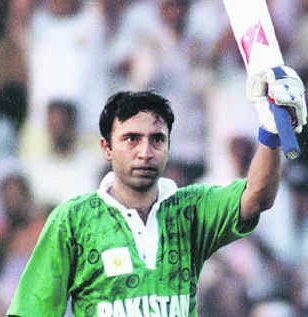
Saeed Anwar (Urdu: سعید انور, born 6 September 1968 in Karachi, Pakistan) is a former Pakistani opening batsman. A left-hander, Anwar is most notable for scoring 194 runs against India in Chennai in 1997, the previous highest and now the joint second highest individual score in a One Day International.
Personal life
Saeed Anwar graduated from NED University, Karachi in 1989 and is an engineer by profession. He was planning to go to the United States for his Master's studies before becoming a professional test Cricketer.
He faced a personal tragedy in 2001, when his daughter died after a prolonged illness. As a result he turned to religion. He made his return to Cricket after a long hiatus and was one of the most consistent Pakistani batsmen in the 2003 World Cup.
On 15 August 2003, he announced his retirement from Cricket after he was dropped from the squad for the upcoming One-Day International tournament in Sharjah. He devoted his life to preaching Islam across Pakistan with the Tablighi Jamaat. He led the funeral prayers for his ex team mate Wasim Akram's spouse, Huma Akram, in Lahore
Anwar used an eclectic approach to batting – classical betrothed to unorthodox, footwork against spin as quick as a hiccup, and wrists supple yet powerful to brush the field like a Picasso.
Ramiz Raja, 2010.
An opening batsman capable of annihilating any bowling attack on his day, Anwar was an attacking batsman in one-day matches and once settled in Test matches, scored quickly and all over the field. His success came from good timing and wrist flicks rather than physical power, and Anwar became famous for his trademark flick. He was able to lift a ball that had pitched outside off stump for six over midwicket. Anwar's timing and ability to score quick runs made him a crowd favourite. He was named as a Wisden Cricketer of the Year in 1997.
Anwar was the first Pakistani batsman to score a century against India on Indian soil in a one-day match. He has the highest Test batting average (59.06) of any Pakistani against Australia, and once scored three consecutive centuries against them. He scored a classic century against South Africa in Durban, which allowed Pakistan to win a Test match for the first time in South Africa.
On 21 May 1997 in Chennai, Anwar scored 194 against India in an ODI match.[8] Charles Coventry equalled the feat on 16 August 2009, against Bangladesh This was the highest individual score by any batsman in the world till Sachin Tendulkar scored an unbeaten 200 against South Africa on 24 February 2010.
Anwar is a member of the exclusive club of batsmen who have scored three successive hundreds in ODIs, with hundreds against Sri Lanka, West Indies and Sri Lanka during the 1993–94 Champions Trophy in Sharjah. He scored two successive hundreds on three other occasions in his career, and was the first batsman to complete this feat in ODIs.
Saeed Anwar's career performance graph.
Anwar (194) and Charles Coventry (194*) shared the record for highest individual score in an ODI match until it was overtaken by India's Sachin Tendulkar (200*) against South Africa on 24 February 2010. Anwar has scored two or more successive hundreds on four occasions. He holds the highest Test batting average (59.06) of any Pakistani against Australia in Test matches, and made 20 hundreds in One Day Internationals as a Pakistan opening batsman.
Saeed Anwar
Saeed Anwar
Saeed Anwar
Saeed Anwar
Saeed Anwar
Saeed Anwar
Saeed Anwar
Saeed Anwar
Saeed Anwar's 194 vs India
Saeed Anwar 119 vs Australia 1999 GABBA
Saeed Anwar 126 off 99 balls vs Sri Lanka 1989/90 Adelaide
Inzamam ul-Haq Biography
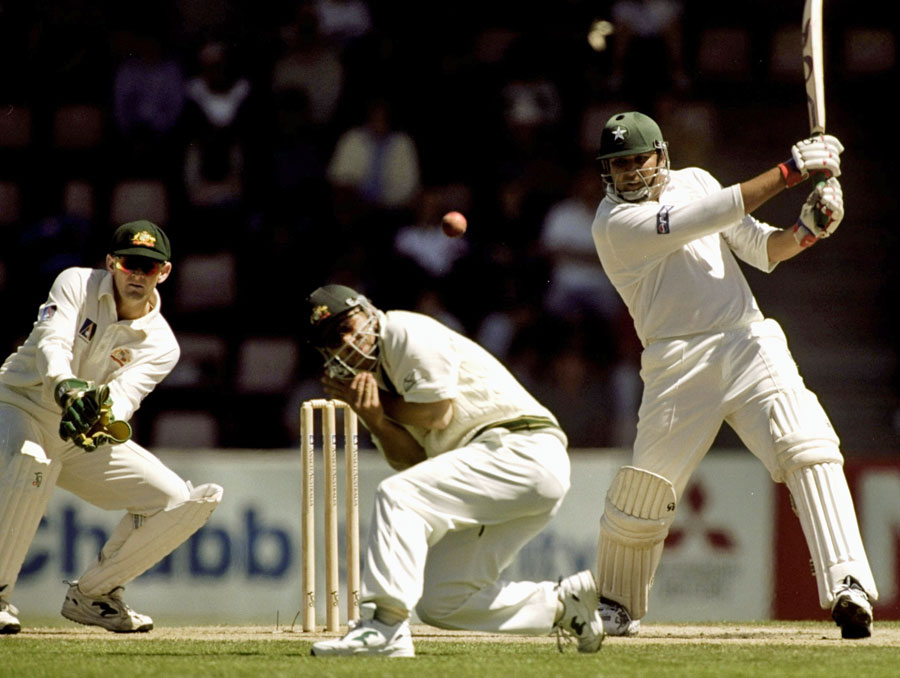
Inzamam-ul-Haq (born 3 March 1970) is a Pakistani cricketer. He is considered to be one of Pakistan’s best batsmen.He is currently the captain of the Pakistani team.Test Debut: Pakistan v England at Birmingham, 1st Test, 1992. His career highlights are:
Scoring 60 in 37 balls against New Zealand in the semifinal of the 1992 World Cup to win the match that was nearly lost.
Scoring 329 against New Zealand in Lahore during a Test in the 2001-02 season (the twelfth highest score by a batsman)
Scoring 138* to deny Bangladesh victory at Multan.
Becoming the second batsman to score 10,000 runs in one-day inernationals (behind Sachin Tendulkar)
Scoring 184 in his 100th Test, against India at Bangalore in 2005.
Inzamam ul-Haq is well-known for his poor running between the wickets (as of May 2005, he has been run out a record 38 times in one-day internationals) and his ability to play shots around the ground. He has been described as looking “like a passenger in the field”.
He averages just over 50 runs per innings in tests and nearly 40 runs in one-day internationals with a strike rate of 53.65 and 74.20 respectively (figures current as of May 2004). He is called the best batsmen in the world against pace by Imran Khan. Inzamam is a giant that has a very soft touch for a man of his bulk. He usually bats at number three with his sidekick Yousuf Youhana.
He plays shots all round the wicket, is especially strong off his legs, and unleashes ferocious pulls and lofted drives.
Inzamam ul-Haq
Inzamam ul-Haq
Inzamam ul-Haq
Inzamam ul-Haq
Inzamam ul-Haq
Inzamam ul-Haq
Inzamam ul-Haq
Inzamam ul-Haq
Inzamam-Ul-Haq 130 vs New Zealand 2nd test 2000/01
Mohammad Yousuf Biography
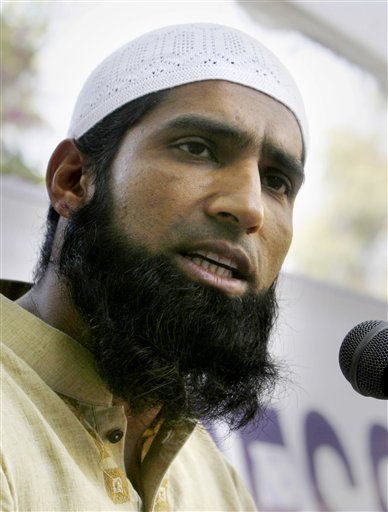
Full name Mohammad Yousuf
Born August 27, 1974, Lahore, Punjab
Current age 37 years 19 days
Major teams Pakistan, Asia XI, Bahawalpur, Lahore, Lahore Badshahs, Lancashire, Pakistan International Airlines, Warwickshire, Water and Power Development Authority, Zarai Taraqiati Bank Limited
Career statistics Test debut South Africa v Pakistan at Durban, Feb 26-Mar 2, 1998 scorecard
Last Test England v Pakistan at Lord's, Aug 26-29, 2010 scorecard
Test statistics
ODI debut Zimbabwe v Pakistan at Harare, Mar 28, 1998 scorecard
Last ODI Pakistan v South Africa at Dubai (DSC), Nov 8, 2010 scorecard
ODI statistics
T20I debut England v Pakistan at Bristol, Aug 28, 2006 scorecard
Last T20I England v Pakistan at Cardiff, Sep 7, 2010 scorecard
T20I statistics
First-class debut 1996/97
Last First-class Warwickshire v Durham at Birmingham, May 24-27, 2011 scorecard
List A debut 1996/97
Last List A Warwickshire v Durham at Birmingham, May 22, 2011 scorecard
Twenty20 debut Karachi Dolphins v Lahore Lions at Lahore, Apr 25, 2005 scorecard
Last Twenty20 Lahore Lions v Rawalpindi Rams at Faisalabad, Jun 30, 2011 scorecard
Recent matches Bat & Bowl Team Opposition Ground Match Date Scorecard
35 Lahore Lions v R Rams Faisalabad 30 Jun 2011 Twenty20
5 Lahore Lions v Hawks Faisalabad 29 Jun 2011 Twenty20
18 Lahore Lions v Leopards Faisalabad 27 Jun 2011 Twenty20
13 Lahore Lions v S Stallions Faisalabad 25 Jun 2011 Twenty20
0, 0 Warwickshire v Durham Birmingham 24 May 2011 First-class
74* Warwickshire v Durham Birmingham 22 May 2011 List A
27 Warwickshire v Notts Nottingham 18 May 2011 First-class
0* Warwickshire v Leics Leicester 15 May 2011 List A
109, 68 Warwickshire v Worcs Birmingham 11 May 2011 First-class
72 Warwickshire v Northants Northampton 8 May 2011 List A
Profile
This much is at least certain that few Pakistani batsmen have been as elegant as Mohammd Yousuf and fewer still have been as prolific, as hungry to bat as long and bat as big.
Read More
Timeline
February 26, 1998
Inauspicious debut
March 28, 1998
One-day debut is better
November 10, 1998
Maiden ton in vain
Read All »
« Prev Showing 1 of 9 Next »
Best Performances
115 v West Indies, Barbados, 2000
100* v India, Dhaka, 2000
124 v England, Lahore, 2000-01
Mohammad Yousuf
Mohammad Yousuf
Mohammad Yousuf
Mohammad Yousuf
Mohammad Yousuf
Mohammad Yousuf
Mohammad Yousuf
Mohammad Yousuf
Mohammad Yousuf 192 - England v Pakistan 3rd test at Leeds 2006
Mohammad Yousuf 128 vs England
Mohammad Yousuf 202 - England v Pakistan 1st test at Lords 2006
Liaquat Ali Khan Biography
Liaquat Ali Khan was among the founding fathers of Pakistan. His contribution to the creation and consolidation of Pakistan has been immense. Yet the fact that no biography of this first Prime Minister of Pakistan and the last Honorary Secretary of the Muslim League has ever been written in English shows how far his role has been neglected. This book has the distinction of being the first biography of this historic figure. It is based on primary and unpublished material like the Jinnah-Liaquat Correspondence, the All-India Muslim League Papers, and the Shamsul Hasan Collection. It contains many interesting disclosures, notably about the Desai-Liaquat talks, Liaquat’s hostility to the British War efforts, and the economic imperatives of the 1947 ‘Poor Man’s Budget’.
It is essential reading for anybody interested in the birth and early years of Pakistan.
"I have read with interest and profit Dr Kazimi’s book on the life of Liaquat Ali Khan and congratulate him on a study that adds considerably to our understanding of Pakistan’s pre-history. I like his objective approach." - Richard Symonds, Author of In the Margins of Independence (OUP 2001)
"This is both an important and original work. It has been very well researched both in regard to original and secondary sources. The thesis constitutes an important addition to scholarship on the life of Liquat Ali Khan as well as the Pakistan Movement." - Charles H. Kennedy, Director, American Institute of Pakistan Studies
"Kazimi’s ‘Liaquat Ali Khan: His Life and Work’ is an excellent biography in every way, lucid, comprehensive, accurate; the best introduction to Quaid-i-Azam’s foremost lieutenant of the Muslim League and Pakistan’s first Prime Minister." - Stanley Wolpert, Professor Emeritus of South Asian History, University of California, Los Angeles.
Liaquat Ali Khan
Liaquat Ali Khan
Liaquat Ali Khan
Liaquat Ali Khan
Liaquat Ali Khan
Liaquat Ali Khan
Liaquat Ali Khan
Liaquat Ali Khan
Liaquat Ali Khan ko kis ne Shaheed kia tha
Prime Minister Liaqat Ali Khan's Speech on 14th August 1948
Memories of Quaid e Millat Nawabzadah Khan Liaquat Ali Khan
Allama Muhammad Iqbal Biography
Iqbal was an heir to a very rich literary, mystic, philosophical and religious tradition. He imbibed and assimilated all that was best in the past and present Islamic and Oriental thought and culture. His range of interests covered Religion, Philosophy, Art, Politics, Economics, the revival of Muslim life and universal brotherhood of man. His prose, not only in his national language but also in English, was powerful. His two books in English demonstrate his mastery of English. But poetry was his medium par excellence of expression. Everything he thought and felt, almost involuntarily shaped itself into verse.
Iqbal's Works
His first book Ilm ul Iqtisad/The knowledge of Economics was written in Urdu in 1903 . His first poetic work Asrar-i Khudi (1915) was followed by Rumuz-I Bekhudi (1917). Payam-i Mashriq appeared in 1923, Zabur-i Ajam in 1927, Javid Nama in 1932, Pas cheh bayed kard ai Aqwam-i Sharq in 1936, and Armughan-i Hijaz in 1938. All these books were in Persian. The last one, published posthumously is mainly in Persian: only a small portion comprises Urdu poems and ghazals.
His first book of poetry in Urdu, Bang-i Dara (1924) was followed by Bal-i Jibril in 1935 and Zarb-i Kalim in 1936.
Bang-i Dara consist of selected poems belonging to the three preliminary phases of Iqbal's poetic career. Bal-i Jibril is the peak of Iqbal's Urdu poetry. It consists of ghazals, poems, quatrains, epigrams and displays the vision and intellect necessary to foster sincerity and firm belief in the heart of the ummah and turn its members into true believers. Zarb-i Kalim was described by the poet himself "as a declaration of war against the present era". The main subjects of the book are Islam and the Muslims, education and upbringing, woman, literature and fine arts, politics of the East and the West. In Asrar-i Khudi, Iqbal has explained his philosohy of "Self". He proves by various means that the whole universe obeys the will of the "Self". Iqbal condemns self-destruction. For him the aim of life is self-relization and self-knowledge. He charts the stages through which the "Self" has to pass before finally arriving at its point of perfection, enabling the knower of the "Self" to become the viceregent of Allah on earth/Khalifat ullah fi'l ard. In Rumuz-i Bekhudi, Iqbal proves that Islamic way of life is the best code of conduct for a nation's viability. A person must keep his individual characteristics intact but once this is achieved he should sacrifice his personal ambitions for the needs of the nation. Man cannot realize the "Self" out of society. Payam-i Mashriq is an answer to West-Istlicher Divan by Goethe, the famous German peot. Goethe bemoaned that the West had become too materialistic in outlook and expected that the East would provide a message of hope that would resuscitate spiritual values. A hundred years went by and then Iqbal reminded the West of the importance of morality, religion and civilization by underlining the need for cultivating feeling, ardour and dynamism. He explained that life could, never aspire for higher dimensions unless it learnt of the nature of spirituality.
Zabur-i Ajam includes the Mathnavi Gulshan-i Raz-i Jadid and Bandagi Nama. In Gulshan-i Raz-i Jadid, he follows the famous Mathnavi Gulshan-i Raz by Sayyid Mahmud Shabistri. Here like Shabistri, Iqbal first poses questions, then answers them with the help of ancient and modern insight and shows how it effects and concerns the world of action. Bandagi Nama is in fact a vigorous campaign against slavery and subjugation. He explains the spirit behind the fine arts of enslaved societies. In Zabur-i Ajam, Iqbal's Persian ghazal is at its best as his Urdu ghazal is in Bal-i Jibril. Here as in other books, Iqbal insists on remembering the past, doing well in the present and preparing for the future. His lesson is that one should be dynamic, full of zest for action and full of love and life. Implicitly, he proves that there is no form of poetry which can equal the ghazal in vigour and liveliness. In Javid Nama, Iqbal follows Ibn-Arabi, Marri and Dante. Iqbal depicts himself as Zinda Rud (a stream, full of life) guided by Rumi the master, through various heavens and spheres and has the honour of approaching Divinity and coming in contact with divine illuminations. Several problems of life are discussed and answers are provided to them. It is an exceedingly enlivening study. His hand falls heavily on the traitors to their nation like Mir Jafar from Bengal and Mir Sadiq from the Deccan, who were instrumental in the defeat and death of Nawab Siraj-ud-Daula of Bengal and Sultan Tipu of Mysore respectively by betraying them for the benefit of the British. Thus, they delivered their country to the shackles of slavery. At the end, by addressing his son Javid, he speaks to the young people at large and provides guidance to the "new generation".
Pas Cheh Bay ed Kard ai Aqwam-i Sharq includes the mathnavi Musafir. Iqbal's Rumi, the master, utters this glad tiding "East awakes from its slumbers" "Khwab-i ghaflat". Inspiring detailed commentary on voluntary poverty and free man, followed by an exposition of the mysteries of Islamic laws and sufic perceptions is given. He laments the dissention among the Indian as well as Muslim nations. Mathnavi Musafir, is an account of a journey to Afghanistan. In the mathnavi the people of the Frontier (Pathans) are counseled to learn the "secret of Islam" and to "build up the self" within themselves.
Armughan-i Hijaz consists of two parts. The first contains quatrains in Persian; the second contains some poems and epigrams in Urdu. The Persian quatrains convey the impression as though the poet is travelling through Hijaz in his imaginatin. Profundity of ideas and intensity of passion are the salient features of these short poems. The Urdu portion of the book contains some categorical criticism of the intellectual movements and social and political revolutions of the modern age.
Iqbal's English Works
Iqbal wrote two books in English. The first being The Development of Metaphysics in Persia in which continuity of Persian thought is discussed and sufism is dealt with in detail. In Iqbal's view true Islamic Sufism awakens the slumbering soul to a higher idea of life.
The second book, The Reconstruction of Religious Thought in Islam, is the collection of Iqbal's six lectures which he delivered at Madras, Hyderabad and Aligarh. These were first published from Lahore in 1930 and then by Oxford University Press in 1934. Some of the main subjects are "Knowledge and Religious Experience," "The Conception of God and the Meaning of Prayer," "The Human Ego," "Predestination and Free Will," "The Spirit of Muslim Culture," "The Principle of Movement in Islam (Ijtihad)." These issues are discussed pithily in a thought provoking manner in the light of Islam and the modern age. These lectures were translated into Urdu by Sayyid Nazir Niazi.
Letters
In addition to these books he wrote hundreds of letters in Urdu and English. Urdu letters have been published in ten different books. He issued statements pertaining to the burning topics of the day relating to various aspects of social, religious, cultural and political problems of India, Europe and the world of Islam. For a few years he served as a Professor of Philosophy and Oriental Learning at the government College, Lahore and the Punjab University Oriental College. Many of his speeches and statements have been compiled and published in book form. Except for the last four years of his life he practised at the Lahore High Court Bar. All his life he was easily accessible to all and sundry and evening sessions at his home were a common feature.
In Spite of his heavy political and social commitments he had time for poetry, a poetry which made philosophy sing. A.K Brohi says:
Dr. Iqbal is undoubtedly a renowned poet-philosopher of Islam and may have in his writings a never failing source of inspiration, delight and aesthetic wonder. He has made signal contribution to our understanding of the Holy Writ of Islam and offered his evaluation of the remarkable example of which the life of the Prophet of Islam (pbuh) has presented to the world at large and the high water-mark of excellence, it provides of how best our earthly lives can be lived here below.
Iqbal The Visionary
Iqbal joined the London branch of the All India Muslim League while he was studying Law and Philosophy in England. It was in London when he had a mystical experience. The ghazal containing those divinations is the only one whose year and month of composition is expressly mentioned. It is March 1907. No other ghazal, before or after it has been given such importance. Some verses of that ghazal are:
At last the silent tongue of Hijaz has
announced to the ardent ear the tiding
That the covenant which had been given to the
desert-dwelles is going to be renewed
vigorously:
The lion who had emerged from the desert and
had toppled the Roman Empire is
As I am told by the angels, about to get up
again (from his slumbers.)
You the dwelles of the West, should know that
the world of God is not a shop (of yours).
Your imagined pure gold is about to lose it
standard value (as fixed by you).
Your civilization will commit suicide with its
own daggers.
A nest built on a frail bough cannot be
durable.
The caravan of feeble ants will take the rose
petal for a boat
And inspite of all blasts of waves, it shall cross
the river.
I will take out may worn-out caravan in the
pitch darkness of night.
My sighs will emit sparks and my breath will
produce flames.
For Iqbal it was a divinely inspired insight. He disclosed this to his listeners in December 1931, when he was invited to Cambridge to address the students. Iqbal was in London, participating in the Second Round Table Conference in 1931. At Cambridge, he referred to what he had proclaimed in 1906:
I would like to offer a few pieces of advice to the youngmen who are at present studying at Cambridge ...... I advise you to guard against atheism and materialism. The biggest blunder made by Europe was the separation of Church and State. This deprived their culture of moral soul and diverted it to the atheistic materialism. I had twenty-five years ago seen through the drawbacks of this civilization and therefore had made some prophecies. They had been delivered by my tongue although I did not quite understand them. This happened in 1907..... After six or seven years, my prophecies came true, word by word. The European war of 1914 was an outcome of the aforesaid mistakes made by the European nations in the separation of the Church and the State.
It should be stressed that Iqbal felt he had received a spiritual message in 1907 which even to him was, at that juncture, not clear. Its full import dawned on him later. The verses quoted above show that Iqbal had taken a bold decision about himself as well. Keeping in view that contemporary circumstances, he had decided to give a lead to the Muslim ummah and bring it out of the dark dungeon of slavery to the shining vasts of Independence. This theme was repeated later in poems such as "Abdul Qadir Ke Nam," "Sham-o-Sha'ir," "Javab-i Shikwa," "Khizr-i Rah," "Tulu-e Islam" etc. He never lost heart. His first and foremost concern, naturally, were the Indian Muslims. He was certain that the day of Islamic resurgence was about to dawn and the Muslims of the South Asian subcontinent were destined to play a prominent role in it.
Iqbal, confident in Allah's grand scheme and His aid, created a new world and imparted a new life to our being. Building upon Sir Sayyid Ahmed's two-nation theory, absorbing the teaching of Shibli, Ameer Ali, Hasrat Mohani and other great Indian Muslim thinkers and politicians, listening to Hindu and British voices, and watching the fermenting Indian scene closely for approximately 60 years, he knew and ultimately convinced his people and their leaders, particularly Quaid-i-Azam Muhammad Ali Jinnah that:
"We both are exiles in this land. Both longing for
our dear home's sight!"
"That dear home is Pakistan, on which he harpened like a flute-player, but whose birth he did not witness."
Many verses in Iqbal's poetry are prompted by a similar impulse. A random example, a ghazal from Zabur-i Ajam published in 1927 illustrates his deepseated belief:
The Guide of the Era is about to appear from a
corner of the desert of Hijaz.
The carvan is about to move out from this far
flung valley.
I have observed the kingly majesty on the
faces of the slaves.
Mahmud's splendour is visible in the dust of
Ayaz.
Life laments for ages both in the Ka'bah and
the idol-house.
So that a person who knows the secret may
appear.
The laments that burst forth from the breasts
of the earnestly devoted people. Are going
to initiate a new principle in the conscience of
the world.
Take this harp from my hand. I am done for.
My laments have turned into blood and that
blood is going to trickle from the strings of the
harp.
The five couplets quoted above are prophetic. In the first couplet Allama Iqbal indicates that the appearance of the Guide of the Era was just round the corner and the Caravan is about to start and emerge from "this" valley. Iqbal does not say that the awaited Guide has to emerge from the centre of Hijaz. He says he is going to appear from a far flung valley. For the poet the desert of Hijaz, at times, serves as a symbol for the Muslim ummah. This means that Muslims of the Indian sub-continent are about to have a man who is destined to guide them to the goal of victory and that victory is to initiate the resurgence of Islam.
In the second couplet, he breaks the news of the dawn which is at hand. the slaves are turning into magnificent masters. In the third couplet he stresses the point that the Seers come to the world of man after centuries. He himself was one of those Seers. In the fourth couplet he refers to some ideology or principle quite new to the world which would effect the conscience of all humanity. And what else could it be, if it were not the right of self-determination for which the Muslims of the sub-continent were about to struggle. After the emergence of Pakistan this right became a powerful reference. It served as the advent of a new principle and continues to provide impetus to Muslims in minority in other parts of the world such as in the Philippines, Thailand and North America.
In the fifth couplet Iqbal indicates that he would die before the advent of freedom. He was sure that his verses which epitomized his most earnest sentiments would stand in good stead in exhorting the Muslims of the sub-continent to the goal of freedom.
Iqbal and Politics
These thoughts crystallised at Allahabad Session (December, 1930) of the All India Muslim League, when Iqbal in the Presidential Address, forwarded the idea of a Muslim State in India:
I would like to see the Punjab, North-West Frontier Provinces, Sind and Baluchistan into a single State. Self-Government within the British Empire or without the British Empire. The formation of the consolidated North-West Indian Muslim State appears to be the final destiny of the Muslims, at least of the North-West India.
The seed sown, the idea began to evolve and take root. It soon assumed the shape of Muslim state or states in the western and eastern Muslim majority zones as is obvious from the following lines of Iqbal's letter, of June 21, 1937, to the Quaid-i Azam, only ten months before the former's death:
A separate federation of Muslim Provinces, reformed on the lines I have suggested above, is the only course by which we can secure a peaceful India and save Muslims from the domination of Non-Muslims. Why should not the Muslims of North-West India and Bengal be considered as nations entitled to self-determination just as other nations in India and outside India are.
There are some critics of Allama Iqbal who assume that after delivering the Allahbad Address he had slept over the idea of a Muslim State. Nothing is farther from the truth. The idea remained always alive in his mind. It had naturally to mature and hence, had to take time. He was sure that the Muslims of sub-continent were going to achieve an independent homeland for themselves. On 21st March, 1932, Allama Iqbal delivered the Presidential address at Lahore at the annual session of the All-India Muslim Conference. In that address too he stressed his view regarding nationalism in India and commented on the plight of the Muslims under the circumstances prevailing in the sub-continent. Having attended the Second Round Table Conference in September, 1931 in London, he was keenly aware of the deep-seated Hindu and Sikh prejudice and unaccommodating attitude. He had observed the mind of the British Government. Hence he reiterated his apprehensions and suggested safeguards in respect of the Indian Muslims:
In so far then as the fundamentals of our policy are concerned, I have got nothing fresh to offer. Regarding these I have already expressed my views in my address to the All India Muslim League. In the present address I propose, among other things, to help you, in the first place, in arriving at a correct view of the situation as it emerged from a rather hesitating behavior of our delegation the final stages of the Round-Table Conference. In the second place, I shall try, according to my lights to show how far it is desirable to construct a fresh policy now that the Premier's announcement at the last London Conference has again necessitated a careful survey of the whole situation.
It must be kept in mind that since Maulana Muhammad Ali had died in Jan. 1931 and Quaid-i Azam had stayed behind in London, the responsibility of providing a proper lead to the Indian Muslims had fallen on him alone. He had to assume the role of a jealous guardian of his nation till Quaid-i Azam returned to the sub-continent in 1935.
The League and the Muslim Conference had become the play-thing of petty leaders, who would not resign office, even after a vote of non-confidence! And, of course, they had no organization in the provinces and no influence with the masses.
During the Third Round-Table Conference, Iqbal was invited by the London National League where he addressed an audience which included among others, foreign diplomats, members of the House of Commons, Members of the House of Lords and Muslim members of the R.T.C. delegation. In that gathering he dilated upon the situation of the Indian Muslims. He explained why he wanted the communal settlement first and then the constitutional reforms. He stressed the need for provincial autonomy because autonomy gave the Muslim majority provinces some power to safeguard their rights, cultural traditions and religion. Under the central Government the Muslims were bound to lose their cultural and religious entity at the hands of the overwhelming Hindu majority. He referred to what he had said at Allahabad in 1930 and reiterated his belief that before long people were bound to come round to his viewpoint based on cogent reason.
In his dialogue with Dr. Ambedkar Allama Iqbal expressed his desire to see Indian provinces as autonomous units under the direct control of the British Government and with no central Indian Government. He envisaged autonomous Muslim Provinces in India. Under one Indian union he feared for Muslims, who would suffer in many respects especially with regard to their existentially separate entity as Muslims.
Allama Iqbal's statement explaining the attitude of Muslim delegates to the Round-Table Conference issued in December, 1933 was a rejoinder to Jawahar Lal Nehru's statement. Nehru had said that the attitude of the Muslim delegation was based on "reactionarism." Iqbal concluded his rejoinder with:
In conclusion I must put a straight question to punadi Jawhar Lal, how is India's problem to be solved if the majority community will neither concede the minimum safeguards necessary for the protection of a minority of 80 million people, nor accept the award of a third party; but continue to talk of a kind of nationalism which works out only to its own benefit? This position can admit of only two alternatives. Either the Indian majority community will have to accept for itself the permanent position of an agent of British imperialism in the East, or the country will have to be redistributed on a basis of religious, historical and cultural affinities so as to do away with the question of electorates and the communal problem in its present form.
Allama Iqbal's apprehensions were borne out by the Hindu Congress ministries established in Hindu majority province under the Act of 1935. Muslims in those provinces were given dastardly treatment. This deplorable phenomenon added to Allama Iqbal's misgivings regarding the future of Indian Muslims in case India remained united. In his letters to the Quaid-i Azam written in 1936 and in 1937 he referred to an independent Muslim State comprising North-Western and Eastern Muslim majority zones. Now it was not only the North-Western zones alluded to in the Allahabad Address.
There are some within Pakistan and without, who insist that Allama Iqbal never meant a sovereign Muslim country outside India. Rather he desired a Muslim State within the Indian Union. A State within a State. This is absolutely wrong. What he meant was understood very vividly by his Muslim compatriots as well as the non-Muslims. Why Nehru and others had then tried to show that the idea of Muslim nationalism had no basis at all. Nehru stated:
This idea of a Muslim nation is the figment of a few imaginations only, and, but for the publicity given to it by the Press few people would have heard of it. And even if many people believed in it, it would still vanish at the touch of reality.
Iqbal and the Quaid-i Azam
Who could understand Allama Iqbal better than the Quaid-i Azam himself, who was his awaited "Guide of the Era"? The Quaid-i Azam in the Introduction to Allama Iqbal's lettes addressed to him, admitted that he had agreed with Allama Iqbal regarding a State for Indian Muslims before the latters death in April, 1938. The Quaid stated:
His views were substantially in consonance with my own and had finally led me to the same conclusions as a result of careful examination and study of the constitutional problems facing India and found expression in due course in the united will of Muslim India as adumbrated in the Lahore Resolution of the All-India Muslim League popularly known as the "Pakistan Resolution" passed on 23rd March, 1940.
Furthermore, it was Allama Iqbal who called upon Quaid-i Azam Muhammad Ali Jinnah to lead the Muslims of India to their cherished goal. He preferred the Quaid to other more experienced Muslim leaders such as Sir Aga Khan, Maulana Hasrat Mohani, Nawab Muhammad Isma il Khan, Maulana Shaukat Ali, Nawab Hamid Ullah Khan of Bhopal, Sir Ali Imam, Maulvi Tameez ud-Din Khan, Maulana Abul Kalam, Allama al-Mashriqi and others. But Allama Iqbal had his own reasons. He had found his "Khizr-i Rah", the veiled guide in Quaid-i Azam Muhammad Ali Jinnah who was destined to lead the Indian branch of the Muslim Ummah to their goal of freedom. Allama Iqbal stated:
I know you are a busy man but I do hope you won't mind my writing to you often, as you are the only Muslim in India today to whom the community has right to look up for safe guidance through the storm which is coming to North-West India, and perhaps to the whole of India.
Similar sentiments were expressed by him about three months before his death. Sayyid Nazir Niazi in his book Iqbal Ke Huzur, has stated that the future of the Indian Muslims was being discussed and a tenor of pessimism was visible from what his friends said. At this Allama Iqbal observed:
There is only one way out. Muslim should strengthen Jinnah's hands. They should join the Muslim League. Indian question, as is now being solved, can be countered by our united front against both the Hindus and the English. Without it our demands are not going to be accepted. People say our demands smack of communalism. This is sheer propaganda. These demands relate to the defence of our national existence.
He continued:
The united front can be formed under the leadership of the Muslim League. And the Muslim League can succeed only on account of Jinnah. Now none but Jinnah is capable of leading the Muslims.
Matlub ul-Hasan Sayyid stated that after the Lahore Resolution was passed on March 23, 1940, the Quaid-i Azam said to him:
Iqbal is no more amongst us, but had he been alive he would have been happy to know that we did exactly what he wanted us to do.
But the matter does not end here. Allama Iqbal in his letter of March 29, 1937 to the Quaid-i Azam had said:
While we are ready to cooperate with other progressive parties in the country, we must not ignore the fact that the whole future of Islam as a moral and political force in Asia rests very largely on a complete organization of Indian Muslims.
According to Allama Iqbal the future of Islam as a moral and political force not only in India but in the whole of Asia rested on the organization of the Muslims of India led by the Quaid-i Azam.
The "Guide of the Era" Iqbal had envisaged in 1926, was found in the person of Muhammad Ali Jinnah. The "Guide" organized the Muslims of India under the banner of the Muslim League and offered determined resistance to both the Hindu and the English designs for a united Hindu-dominated India. Through their united efforts under the able guidance of Quaid-I Azam Muslims succeeded in dividing India into Pakistan and Bharat and achieving their independent homeland. As observed above, in Allama Iqbal's view, the organization of Indian Muslims which achieved Pakistan would also have to defend other Muslim societies in Asia. The carvan of the resurgence of Islam has to start and come out of this Valley, far off from the centre of the ummah. Let us see how and when, Pakistan prepares itself to shoulder this august responsibility. It is Allama Iqbal's prevision.
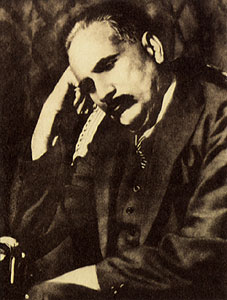
Allama Muhammad Iqbal
Allama Muhammad Iqbal
Allama Muhammad Iqbal
Allama Muhammad Iqbal
Allama Muhammad Iqbal
Allama Muhammad Iqbal
Allama Muhammad Iqbal
Allama Muhammad Iqbal
Allama Iqbal
Tribute to Dr. Allama Muhammad Iqbal - the Poet of the East


 Waqar Younis
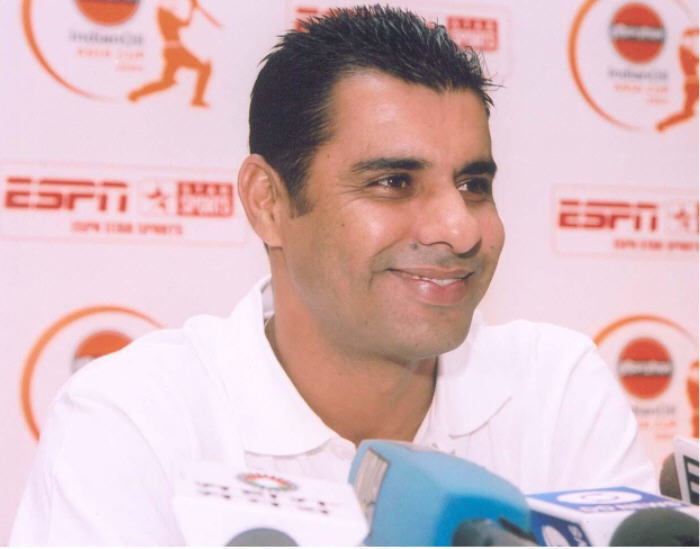 Waqar Younis
 Waqar Younis